Promoted for their expertise. Now they have to lead people.
Modules for new and future team leaders: what leadership actually is, strategy as the art of trade-offs, communication structures, personality and feedback, culture and execution. Designed and delivered by Julien, in English or Arabic.
Free needs call · Outline within 5 working days · No obligation
Right for your team if it includes…
Newly promoted leaders and those about to be promoted
Team leaders looking for their purpose in the team
Leaders who struggle to turn strategy into action alongside daily work
Not the right fit for…
Organisations looking for a one-hour motivational talk
Senior executives looking for board-level strategy consulting
Here is exactly what your team leaders would work on.
The modules
The modules.
Read each module in full: what is covered, and what participants can do afterwards. Tick the ones that fit your team. Nothing is fixed until we have talked: Julien will suggest the right mix, and the order, after a free needs call.
LEAD-01
Foundations of Leadership
For newly promoted leaders, those about to be promoted, and team leaders looking for their purpose in the team
This module explores what leadership actually is and what skillset a leader must develop. It draws on the six functional areas of management set out in the National Occupational Standards for Management and Leadership (Management Standards Centre, developed 2002–2004), on Eugene Jennings' research into the personality traits linked to supervisory success (1952), and on Daniel Goleman's "What Makes a Leader?", which puts emotional intelligence at the centre of effective leadership. Participants work through a fundamental case study, reflect on their own experience, and assess themselves and others. The aim is to avoid a common trap: continuing to focus on being a good individual contributor instead of developing the skills needed to lead others and achieve results through them.
See the 4 topics, and what participants can do afterwards
Introduction to Leadership — a Fundamental Case StudyParticipants can articulate, in their own words, the functions that separate real leadership from title or authority, drawing on the case and on their own experience.
The Six Functional Areas of ManagementParticipants can place their current responsibilities against the six functional areas and identify the areas they have yet to develop.
Characteristics of an Effective Manager — and the Individual-Contributor TrapParticipants can assess themselves and leaders they have worked with against these characteristics, and name where they still act as individual contributors rather than as leaders.
Emotional Intelligence: What Makes a LeaderParticipants can explain what emotional intelligence is in plain language and identify how they will develop it in their own leadership.
LEAD-02the art of tradeoffs
Strategy Fundamentals for Leaders
For newly promoted leaders, those about to be promoted, and team leaders looking for their purpose in the team
The objective of this module is for leaders to make the right trade-offs when operations are under stress. When unexpected shortfalls in resources, manpower or time force a sacrifice, a leader must be clear on what can be good enough and what must be held to the standard of perfection. We explore several frameworks of strategy, including the cases in Michael Porter's "What Is Strategy?", and bring vision and mission to life as real decision-making tools. Applying these frameworks to participants' own workplace reduces impulsive decision-making and reshapes intuition through a deeper understanding of the organisation's overarching goals, against the many factors and players pulling a leader's focus toward the wrong priorities.
See the 4 topics, and what participants can do afterwards
Trade-offs Under Stress: Good Enough vs. PerfectParticipants can name, for their own operation, what can be good enough under pressure and what must never be compromised.
What Is Strategy? Porter's CasesParticipants can tell a genuine strategic choice from an operational-effectiveness improvement, using Porter's distinction.
Sustainable Competitive Advantage vs. the Race for Operational EffectivenessParticipants can describe where their own organisation's competitive advantage comes from, and which daily demands pull their focus away from it.
Vision and Mission as Decision-Making ToolsParticipants can test a real decision from their own work against their organisation's vision and mission, and explain the trade-off they would make.
LEAD-MGT-03
Structural Communication Fundamentals
For newly promoted leaders, those about to be promoted, and team leaders looking for their purpose in the team
This module looks at communication from a structural perspective. The Communication Pyramid places each department or team's communication at the right level; the Shannon & Weaver model of communication, with case studies and exercises, then lets participants evaluate how efficiently the communication systems in their own organisation or department work, and apply the model to their own work scenarios.
See the 4 topics, and what participants can do afterwards
The Communication PyramidParticipants can locate their own team's communication level and needs, and see how those needs differ across the organisation.
The Shannon & Weaver ModelParticipants can design a deliberate communication flow — defined channels, feedback loops, and controls for the 'noise' that distorts messages.
Case Studies and ExercisesParticipants can trace a communication breakdown in a case to the part of the model where it occurred.
Evaluating Your Organisation's Communication SystemParticipants produce an evaluation of their own department's communication system, with its weak points identified.
LEAD-SOFT-04
The DISA Model
For everyone, and especially for newly promoted leaders, those about to be promoted, and team leaders looking for their purpose in the team
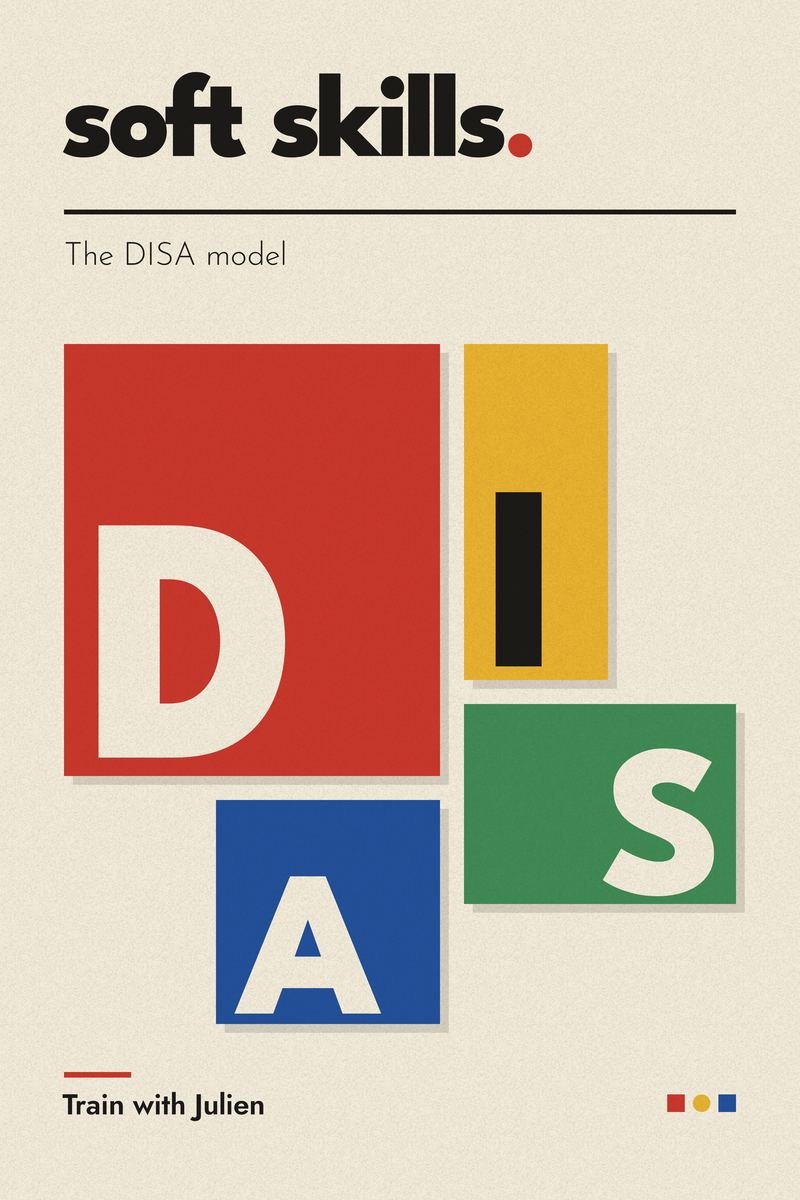
This module gives a very practical framework for analysing and understanding personalities: Thomas Erikson's DISA model. After a presentation of the model and a few case studies, participants apply it, in a non-intrusive and non-judgemental way, to people from their own work environment, to understand why their communication with them is efficient or not, and how to correct it. The module then turns to giving instructions and feedback based on the model, and to how personality affects behaviour, skills and suitability for specific tasks.
See the 5 topics, and what participants can do afterwards
The DISA Model and Case StudiesParticipants can recognise the model's personality profiles in described behaviour.
Analysing People in Your Work EnvironmentParticipants can explain, for specific colleagues, why communication with them works or breaks down.
Correcting Communication: Planning and Practising ConversationsParticipants leave with a planned and rehearsed conversation for a person they find difficult to communicate with.
Giving Instructions and Feedback by PersonalityParticipants can phrase an instruction and a piece of feedback for each personality profile.
Personality, Strengths and Task FitParticipants can assess a team member's strengths and weaknesses for a specific task, using the framework.
LEAD-SOFT-MGT-05
Personal Communication Skills
For everyone, and especially for newly promoted leaders, those about to be promoted, and team leaders looking for their purpose in the team
This module tackles communication from a soft-skills perspective. It moves from non-verbal communication, through listening skills, to emotional intelligence and empathy: understanding your counterpart in order to tune your communication. Its last part uses the DISA model and assumes participants have already been introduced to it (module LEAD-SOFT-04).
See the 3 topics, and what participants can do afterwards
Non-Verbal CommunicationParticipants become aware of the signals they send beyond words and can align them with their message.
Listening SkillsParticipants can place their own listening on the framework's steps and choose the next step to work on.
Emotional Intelligence and Empathy: Tuning Your CommunicationParticipants can adapt the style and content of a message to a specific counterpart in one of their own work scenarios.
LEAD-06
The Cultural Web
For leaders at any level of the organisation and at any stage of their development
This module is about what shapes the paradigm within an organisation: the underlying assumptions and taken-for-granted truths that shape behaviour and the response to instructions, feedback, customer complaints and more. Why do employees in one organisation treat quality as a real standard, while in another they know the word is lip service? The Cultural Web identifies six elements within an organisation that shape these understandings. We present the framework, analyse case studies, then analyse the six elements in participants' own organisation, link them to widespread behaviour, and define a plan for corrective measures.
See the 3 topics, and what participants can do afterwards
The Six Elements of the Cultural WebParticipants can explain how each of the six elements shapes the way people interpret instructions, feedback and standards.
Case StudiesParticipants can trace a widespread behaviour in a case back to the elements of the Cultural Web that produce it.
Your Own Organisation: Diagnosis and Corrective PlanParticipants diagnose their own culture's stories, symbols, routines, structures, controls and power, identify where these contradict the intended direction, and leave with a corrective plan.
LEAD-MGT-07
Systems Analysis and Systems Thinking
For newly promoted leaders, those about to be promoted, and team leaders looking for their purpose in the team
This module runs as a workshop. Participants analyse their own work process to understand their role within their department, and their department's role within the organisation. The analysis leads to a process-mapping exercise that becomes the foundation for troubleshooting communication and prioritisation issues and skill gaps, and possibly for a plan of corrective measures.
See the 3 topics, and what participants can do afterwards
Analysing Your Own Work ProcessParticipants can explain how their own role fits into their department's work, and how the department fits into the organisation.
Process MappingParticipants produce a process map of their own work.
Troubleshooting and Corrective MeasuresParticipants identify the communication, prioritisation and skill issues in their process and, where needed, draft a corrective plan.
LEAD-08
The 4 Disciplines of Execution
For leaders at any level of the organisation who struggle to achieve strategic change and vision because of the ongoing demands of daily work
This module is built on The 4 Disciplines of Execution by Chris McChesney, Sean Covey and Jim Huling: a framework for achieving the few goals that matter most while the day-to-day work — the "whirlwind" — keeps demanding attention. We work through the four disciplines in turn and apply each one to participants' own team.
See the 4 topics, and what participants can do afterwards
Discipline 1: Focus on the Wildly ImportantParticipants draft a Wildly Important Goal for their own team in the "from X to Y by when" form.
Discipline 2: Act on the Lead MeasuresParticipants identify the lead measures that would drive their team's Wildly Important Goal.
Discipline 3: Keep a Compelling ScoreboardParticipants design a simple scoreboard for their team's goal and lead measures.
Discipline 4: Create a Cadence of AccountabilityParticipants plan the format and rhythm of an accountability meeting for their own team.
Every course includes: cases from your sector · delivered by Julien in English or Arabic · applied to their own work · accreditation arranged · personal application plan · HR summary · four-week check-in
You may be wondering whether this fits a team like yours.
Will it fit your team?
Nothing on this page is delivered as it stands. The modules above are what your team can work on; the course itself is put together after a needs call, around your sector, your people’s level and your schedule. Recommended: 3 to 6 hours of training a day, in person across KSA or online, in English or Arabic, with accreditation arranged for you.
Every course follows the same three steps: the model is introduced through cases, practised in the room, then applied by each participant to a real task from their own job before the session ends.
Theory, through cases from your sector
Practice in the room
Applied to their own work
How Julien teaches leadership models: theory first, then your own work.
Results
What people say.
His instructional methodology seamlessly connects core theoretical principles with practical field execution.
One thing I still remember is a lesson he taught us using Bruce Lee’s quote… It really stuck with me — the idea of focusing on one thing and actually mastering it.
Built on Daniel Goleman’s “What Makes a Leader?”, Michael Porter’s “What Is Strategy?”, the Cultural Web and The 4 Disciplines of Execution, applied to your team’s own decisions.
10/10 from every trainee who wrote a review (8 of 8) ·3 of 3 institutes that hired Julien booked him again
One way
Your new team leaders spend their first months finding out by trial and error what leading people involves, while their teams absorb the mistakes.
The other
They leave the course with a clear view of what a leader actually does, a way to decide what can be “good enough” under pressure, and a goal for their own team written in the “from X to Y by when” form.
Your new team leaders will lead either way. The only question is whether they learn how before or after the mistakes.
See your course before you commit.
Send the modules you ticked, or none at all. Julien calls you for 20–30 minutes, then sends a tailored outline and proposal within 5 working days.
If the outline isn’t what you need, say so: he can change the mix, take one module deeper, or build a new course around your goal. You pay nothing and commit to nothing until you accept a proposal.
And if he isn’t the right trainer for what you need, he’ll tell you, and point you to what to look for instead.
Yes. You can book a single module on its own, or tick several; on the needs call, Julien will confirm which fit your goal and how they combine with modules from other topics.
Can one module be covered in more depth?
Yes. If your team needs to focus on one subject, Julien can expand a single module and take it deeper and broader, into a full course of its own.
How long would our course be?
It depends on the modules you choose and the time your team can give. Recommended: 3 to 6 hours of training a day. The length is set with you after the needs call.
Is this for new leaders or experienced ones?
Both. Foundations of Leadership and Strategy Fundamentals are written for newly promoted leaders and those about to be promoted; the Cultural Web and the 4 Disciplines of Execution are for leaders at any level who need to change how their organisation or team works.
Will participants work on their own team’s situation?
Yes. The modules have participants apply each model to their own work, for example diagnosing their own organisation’s culture, drafting a Wildly Important Goal for their own team, or naming what can be “good enough” in their own operation under pressure.