Train withJulien

Courses Communication & Soft Skills

Why some conversations work and others don’t, and what to do about it.

Modules on personality (the DISA model), non-verbal communication, listening, empathy and public speaking, practised on the people and situations from participants’ own work.

  • 3 modules
  • Personality, personal communication, public speaking
  • In person or online
  • English or Arabic
Get your free outline for Communication & Soft Skills

Free needs call · Outline within 5 working days · No obligation

Train with Julien poster: Communication & Soft Skills

Right for your team if it includes…

  • Everyone, and especially new and future team leaders
  • Staff who must present, chair meetings or speak in front of an audience
  • Teams where friction between people slows the work

Not the right fit for…

  • Anyone looking for psychological testing or formal personality assessment: DISA is used as a practical, non-judgemental framework

Here is exactly what participants would work on.

The modules

The modules.

Read each module in full: what is covered, and what participants can do afterwards. Tick the ones that fit your team. Nothing is fixed until we have talked: Julien will suggest the right mix, and the order, after a free needs call.

LEAD-SOFT-04

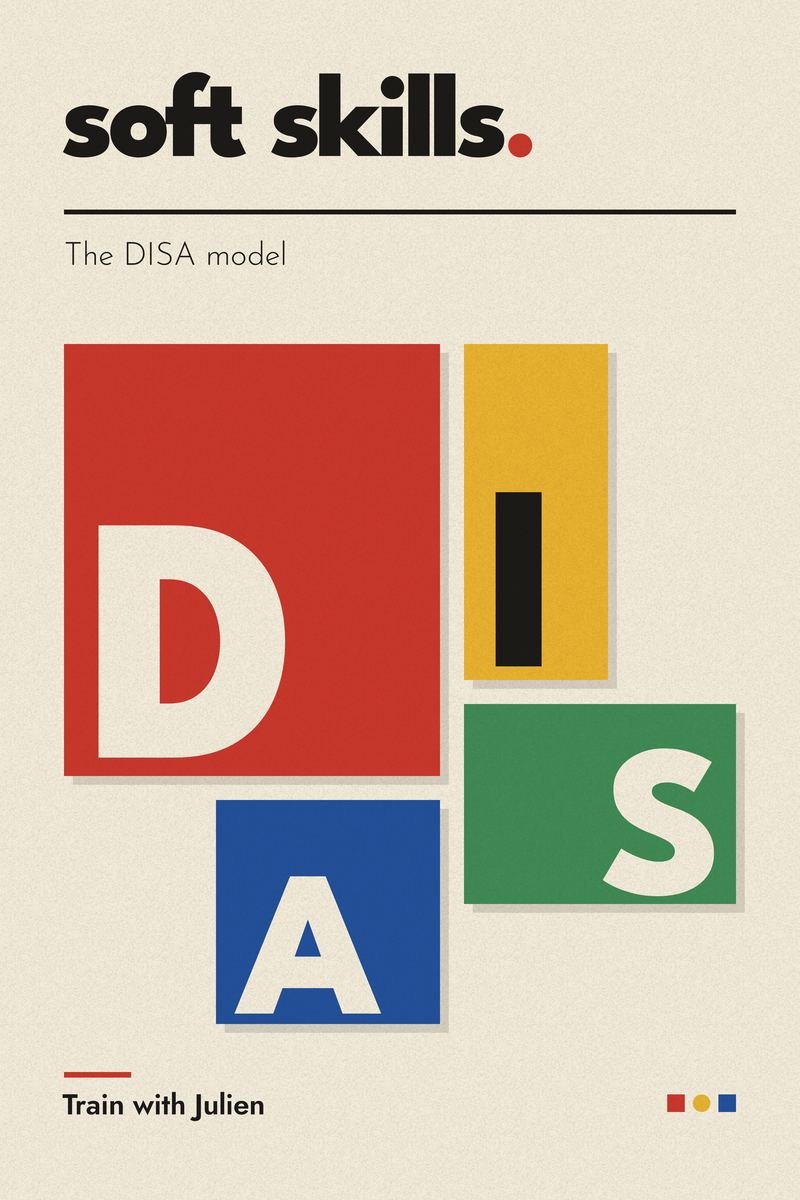
The DISA Model

For everyone, and especially for newly promoted leaders, those about to be promoted, and team leaders looking for their purpose in the team

Also in: Leadership

This module gives a very practical framework for analysing and understanding personalities: Thomas Erikson's DISA model. After a presentation of the model and a few case studies, participants apply it, in a non-intrusive and non-judgemental way, to people from their own work environment, to understand why their communication with them is efficient or not, and how to correct it. The module then turns to giving instructions and feedback based on the model, and to how personality affects behaviour, skills and suitability for specific tasks.

See the 5 topics, and what participants can do afterwards
  1. The DISA Model and Case StudiesParticipants can recognise the model's personality profiles in described behaviour.
  2. Analysing People in Your Work EnvironmentParticipants can explain, for specific colleagues, why communication with them works or breaks down.
  3. Correcting Communication: Planning and Practising ConversationsParticipants leave with a planned and rehearsed conversation for a person they find difficult to communicate with.
  4. Giving Instructions and Feedback by PersonalityParticipants can phrase an instruction and a piece of feedback for each personality profile.
  5. Personality, Strengths and Task FitParticipants can assess a team member's strengths and weaknesses for a specific task, using the framework.
LEAD-SOFT-MGT-05

Personal Communication Skills

For everyone, and especially for newly promoted leaders, those about to be promoted, and team leaders looking for their purpose in the team

Also in: Leadership · Management

This module tackles communication from a soft-skills perspective. It moves from non-verbal communication, through listening skills, to emotional intelligence and empathy: understanding your counterpart in order to tune your communication. Its last part uses the DISA model and assumes participants have already been introduced to it (module LEAD-SOFT-04).

See the 3 topics, and what participants can do afterwards
  1. Non-Verbal CommunicationParticipants become aware of the signals they send beyond words and can align them with their message.
  2. Listening SkillsParticipants can place their own listening on the framework's steps and choose the next step to work on.
  3. Emotional Intelligence and Empathy: Tuning Your CommunicationParticipants can adapt the style and content of a message to a specific counterpart in one of their own work scenarios.
SOFT-01

Public Speaking

For everyone

This module dives into the most important elements of public speaking. Whether giving a keynote speech, delivering a presentation or chairing a meeting, certain elements are crucial to delivering impact. We start with non-verbal communication, practised through exercises and games, then explore a basic storytelling framework and the content mix that makes a good public speech. Participants prepare a work-related presentation for the second day of the module, and multiple exercises take them through easy steps to make them comfortable speaking in front of an audience.

See the 4 topics, and what participants can do afterwards
  1. Non-Verbal Communication in PracticeParticipants can consciously use the non-verbal elements of their delivery in front of an audience.
  2. A Basic Storytelling FrameworkParticipants can structure a short, work-related story with the framework.
  3. The Content Mix of a Good SpeechParticipants can plan the content of a talk for a given audience and occasion.
  4. Delivering Your Own PresentationEvery participant delivers a prepared, work-related presentation in front of the group.

Every course includes: cases from your sector · delivered by Julien in English or Arabic · applied to their own work · accreditation arranged · personal application plan · HR summary · four-week check-in

You may be wondering whether this fits a team like yours.

Will it fit your team?

Nothing on this page is delivered as it stands. The modules above are what your team can work on; the course itself is put together after a needs call, around your sector, your people’s level and your schedule. Recommended: 3 to 6 hours of training a day, in person across KSA or online, in English or Arabic, with accreditation arranged for you.

Every course follows the same three steps: the model is introduced through cases, practised in the room, then applied by each participant to a real task from their own job before the session ends.

  1. Theory, through cases from your sector
  2. Practice in the room
  3. Applied to their own work

Communication is where trainees and HR notice the change first.

Results

What people say.

The feedback from delegates was incredibly positive, they have taken away some very valuable skills, particularly in the area of client communication.

Isa DavenportIsa DavenportHuman Resources DirectorDesert Gate Tourism

He always encouraged me to participate, build confidence, and apply English in real life situations… I significantly improved my communication skills and gained confidence…

4-month English & professional communication course
Abdurahman AllabadisAbdurahman AllabadisWellness Tourism TraineeRed Sea Global

Uses Thomas Erikson’s DISA model, the Skills Builder Universal Framework for listening, and a storytelling framework for public speaking, practised on situations from participants’ own work.

10/10 from every trainee who wrote a review (8 of 8) 3 of 3 institutes that hired Julien booked him again

One way

The same misunderstandings between the same people keep slowing the work, and nobody quite knows why.

The other

Participants can explain why communication with a specific colleague works or breaks down, plan the conversation that fixes it, and stand in front of a group with a message people remember.

The misunderstandings will keep happening either way. The question is whether your people know why, and what to change.

See your course before you commit.

Send the modules you ticked, or none at all. Julien calls you for 20–30 minutes, then sends a tailored outline and proposal within 5 working days.

If the outline isn’t what you need, say so: he can change the mix, take one module deeper, or build a new course around your goal. You pay nothing and commit to nothing until you accept a proposal.

And if he isn’t the right trainer for what you need, he’ll tell you, and point you to what to look for instead.

Get an outline built from these modules

Free needs call · Outline within 5 working days · No obligation

Prefer WhatsApp? +352 621 248 147 · Training institute? Talk about your client’s course →

Frequently asked questions.

Can we choose only some of these modules?

Yes. You can book a single module on its own, or tick several; on the needs call, Julien will confirm which fit your goal and how they combine with modules from other topics.

Can one module be covered in more depth?

Yes. If your team needs to focus on one subject, Julien can expand a single module and take it deeper and broader, into a full course of its own.

How long would our course be?

It depends on the modules you choose and the time your team can give. Recommended: 3 to 6 hours of training a day. The length is set with you after the needs call.

Is the DISA model a personality test?

No. It is used as a practical, non-judgemental framework to understand why communication with a colleague works or breaks down, and how to adjust it.

Our staff are nervous about public speaking. Is that a problem?

That is who the module is for. Participants practise in easy steps, then deliver a short work-related presentation of their own.

Get your free outline for Communication & Soft Skills

Train with Julien poster wall: leadership, management skills, soft skills, agentic AI

Get your free course outline.

Nothing is fixed until we’ve talked. Tick modules as a starting point, or just tell me what you want to change. Julien will reply to arrange a free 20–30 minute needs call, then send a tailored outline and proposal within 5 working days.

Free · No obligation · Your details are only used to reply to you.